
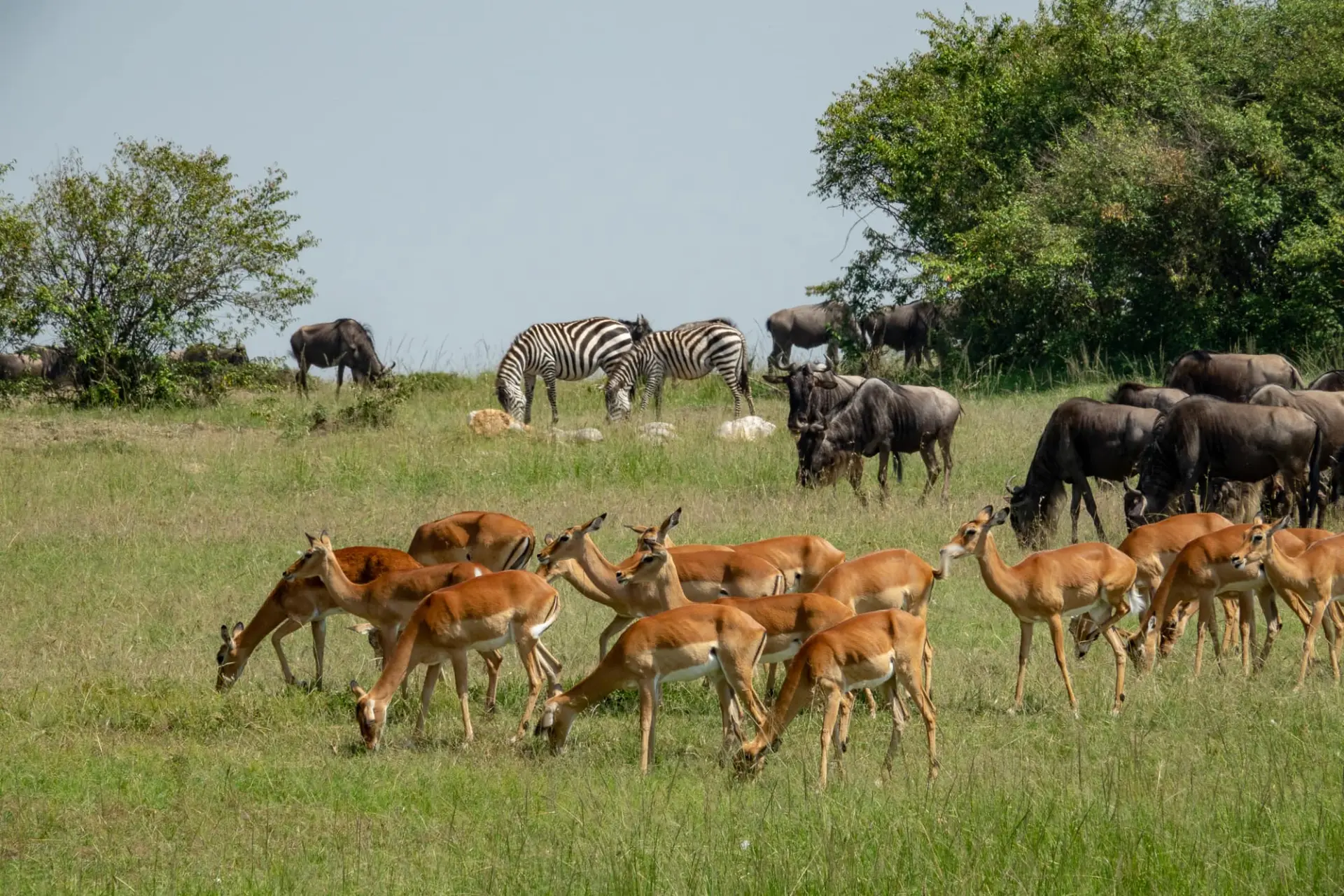
A great migration calendar is the single most useful tool for timing a Kenya or Tanzania safari, because the herd is never in one place for long. Roughly 1.5 million wildebeest, plus zebra and gazelle, move in a rough circuit through the year chasing rain and fresh grass.
- FromUSD 100 to 200Mara park ticket, low versus high season
- DurationRead time 9 min
- StartsApplies to the Maasai Mara and the Serengeti
- Best forAnyone timing a safari around the wildebeest migration
Rated 5.0 on Google from 46 reviews. Price confirmed in writing before you pay.
This great migration calendar breaks the year into months, showing where the herd usually is and what that means for your safari. Timing is never exact, since rainfall shifts the herd earlier or later each year, but the general pattern repeats reliably enough to plan around.
Use it alongside our full month by month Kenya safari guide if you also want weather and pricing detail beyond the migration itself.
Highlights
- January to March: calving season in the southern Serengeti
- April to May: the herd starts moving north through central Tanzania
- June: the western corridor and the Grumeti River crossings
- July to September: Mara River crossings and peak Maasai Mara season
- October to November: the herd turns south again
- December: back in the short grass plains of the southern Serengeti
Migration season and typical Mara safari price tier
| Months | Herd location | Mara safari tier |
|---|---|---|
| Jan to Mar | Southern Serengeti (Tanzania) | Lower, Mara ticket USD 100 |
| Apr to Jun | Central and western Serengeti | Lower, Mara ticket USD 100 |
| Jul to Oct | Maasai Mara (Kenya) | Higher, Mara ticket USD 200 |
| Nov to Dec | Southern Serengeti (Tanzania) | Transitional, Mara ticket USD 200 to mid Dec |
- The Mara park ticket doubles from USD 100 to USD 200 per person from July, regardless of whether the herd has crossed yet.
- Exact crossing dates vary by year with rainfall, so treat this great migration calendar as a strong guide, not a guarantee.
- A festive season price band usually applies from about 20 December to 3 January across most camps.
Get my exact price on WhatsApp
What a great migration calendar actually tracks
The migration is not one event, it is a year round circuit. Wildebeest, joined by large numbers of zebra and Thomson’s gazelle, move clockwise through the Serengeti Mara ecosystem, always chasing the most recent rain and the freshest grass it produces.
A great migration calendar simplifies that circuit into monthly blocks so you can match your travel dates to a stage of the journey, whether that is calving, a river crossing, or the quieter grazing months in between. None of these stages are exclusive to one country, which is why understanding the full circuit matters even if you only plan to visit Kenya.
January to March: calving season
The herd spends these months on the short grass plains of the southern Serengeti, around Ndutu and Ngorongoro, where roughly 500,000 calves are born over a few concentrated weeks, mostly in February. Predators follow closely, so this period rewards patient game viewing over dramatic action.
This stage sits outside Kenya entirely, in Tanzania, so a Kenya only itinerary will not catch it. It is a strong season for a dedicated Tanzania trip instead, such as our Tanzania safaris from Nairobi.
April to May: the long rains and the move north
As the short grass plains dry out, the herd starts drifting north and west through central Tanzania, often in long, strung out columns that can stretch for kilometres. The long rains fall in this window, which keeps grass green but makes some tracks harder going.
This is generally the quietest, cheapest season across the whole region, since fewer travellers plan around rain, even though the scenery and birdlife are often at their best.
June: the western corridor
By June the herd usually reaches the western Serengeti and the Grumeti River, where smaller crossings happen, sometimes with crocodile action, though on a smaller scale than the Mara River crossings later in the year. This month is a good middle ground: drier weather, thinner crowds than peak season, and still real migration activity.
Camps in the western corridor tend to be smaller and more spread out than those clustered around the Mara in peak season, which suits travellers who want migration scenery without the vehicle numbers that build up at a known crossing point in August.
July to September: Mara River crossings
This is the section of the great migration calendar most people mean when they say migration season. The herd pushes north into Kenya’s Maasai Mara, crossing the Mara River in a series of dramatic, unpredictable crossings that can happen at almost any point along several known crossing sites, including the areas near Lookout Hill and Paradise Plain.
Crossings are never guaranteed on any single day, since the herd can sit at the river’s edge for hours or days before committing. Multiple days in the Mara improve your odds significantly over a single overnight stop, which is why our 4 day Maasai Mara safari tends to outperform a 2 day trip for crossing sightings.
October to November: the return south
As Kenya’s short rains begin, usually in November, the herd starts drifting back south through the Mara and into the northern Serengeti, sometimes recrossing the Mara River in the opposite direction. This stage is less predictable than the July crossings but still active and far less crowded.
Prices and camp availability also ease off in this window compared to the July to September peak, which makes October and early November a favourite for repeat visitors who already caught a crossing on an earlier trip and now want a quieter, cheaper visit.
December: back in the southern plains
By December the herd is usually back in the southern Serengeti, close to where the calving season will begin again in a few weeks, completing the circuit this great migration calendar has followed all year. December also carries Kenya’s festive season price band, so it suits travellers who want Tanzania’s plains rather than a Mara focused trip. See our Christmas and New Year packages if you are travelling over the festive period.
Is the migration better in Kenya or Tanzania
Kenya’s Maasai Mara owns the July to September river crossing season, the single most dramatic stage of the migration and the reason most first time migration travellers head there. Tanzania’s Serengeti covers a longer stretch of the calendar, including calving season and the western corridor, so it suits a longer or repeat trip.
Read our full Kenya versus Tanzania safari comparison and our Maasai Mara versus Serengeti guide for a deeper look at cost, access and which suits your dates.
How to time a trip around this calendar
If a river crossing is the priority, book 4 or more nights in the Mara between late July and September, since more nights mean more chances to be at the right crossing point on the right day. A shorter 2 or 3 night trip can still see the migration in season, just with lower odds of a crossing specifically.
If you would rather avoid crowds and higher prices, target June or October to November for the herd itself, or focus on calving season in Tanzania between late January and March. Our Maasai Mara and Serengeti migration safari combines both sides of the border on one trip.
Why this great migration calendar is a guide, not a guarantee
Every year the rains fall a little differently, and the herd responds to rain, not to a calendar date. A late wet season can push the northward move back by 2 or 3 weeks, and an early one can pull it forward just as much, so a fixed date booked a year out is always an educated guess rather than a certainty.
Camps and guides who watch the herd daily adjust their own recommendations through the season, which is one reason we check current herd position with our contacts on the ground before confirming your exact dates, rather than relying only on the averages in this great migration calendar. That extra step usually happens a few weeks before you travel, once the picture for that specific season is clearer.
Balloon flights and the great migration calendar
A hot air balloon flight over the Mara is at its most popular during the July to September peak, when a balloon can pass directly over large herds and, occasionally, a crossing in progress. Book this well ahead of your trip, since balloon seats sell out fastest exactly when the migration itself is at its best.
See our Maasai Mara hot air balloon safari page for pricing and what a flight actually involves.
Great migration calendar tips from the ground
Base yourself close to a known crossing point rather than moving camps every night during peak crossing season, since travel time between camps eats into the hours you could spend waiting at the river. Ask your camp for a daily update, since staff and guides share sightings across properties by radio through the morning.
Early morning and late afternoon give the best light for photography and are also when crossings are somewhat more likely, though never guaranteed. Patience matters more than any other single factor on a migration focused trip, and a flexible daily plan beats a rigid one built around a single fixed sighting.
Booking ahead for migration season
Camps in the Mara and northern Serengeti fill up well ahead of July to September, often 6 to 12 months out for the better properties. If your dates are fixed to peak migration season, start planning early rather than a few weeks before you travel.
Our Great migration safaris hub lists ready built itineraries for every stage of this great migration calendar, from a Mara focused short trip to a longer Kenya and Tanzania combination that covers several stages of the year in one holiday.
Turn this great migration calendar guide into a real trip
Reading about great migration calendar is the fun part. Planning around it is where most people get stuck. Here is how we take you from an idea to a confirmed trip, step by step, with no surprises.
- Send your dates. Message us on WhatsApp with your travel dates, how many people are coming and the ages of any children. Tell us if you have a budget in mind. We plan with it, not around it.
- Get a written quote. We reply with a clear price per person, what it includes and what it does not. No hidden park fees and no vague extras. If a cheaper camp or a shorter route makes more sense, we say so.
- Tweak it until it fits. Change a camp, add a night or swap a park. Ask as many questions as you like. Changes cost nothing until you confirm.
- Confirm with a deposit. A deposit holds your vehicle, guide and rooms. You get a written confirmation with every detail and the date the balance is due.
- Travel day. Your driver guide meets you at your hotel or the airport with a name board. You have their number and ours for the whole trip.
What every trip with us includes
Every great migration calendar plan we put together comes with the basics done properly. You ride in a safari vehicle with a pop up roof, with a professional driver guide who knows the parks. Water is in the cooler box, and park fees are sorted in advance so you do not stand in a queue at the gate.
We also stay reachable. If something changes on the road, a flat tyre, a closed route or a sudden storm, we sort it and keep you posted on WhatsApp.
Paying safely
We share payment details in writing only, and every payment gets a receipt. The payment options and the balance date sit on your written quote, so nothing is left to memory or a phone call.
Why book with a Nairobi team
We live here. We drive these roads all year, we know which camps are honest about their photos, and we know when a park is too busy to enjoy. That local knowledge is what turns a good great migration calendar into a great one. Our Google rating sits at 5.0 from 46 reviews, and we plan to keep it that way.
Ready when you are. Send us a message and we will put a plan together for you shortly.
Questions people ask
When is the Great Migration in Kenya?
The herd is usually in Kenya’s Maasai Mara from around July through October, with the famous Mara River crossings concentrated in August and September. Exact timing shifts a few weeks earlier or later each year depending on rainfall, so this great migration calendar is a strong guide rather than a fixed date.
When do the Mara River crossings happen?
Most crossings happen between late July and September, though the herd can sit at the river’s edge for days before committing, or cross at several different points without warning. Multiple nights in the Mara improve your chances of witnessing one.
Where is the herd in each month?
Broadly: January to March in the southern Serengeti for calving, April to June moving north and west through central and western Tanzania, July to October in Kenya’s Maasai Mara, and November to December heading back south. This great migration calendar breaks each stage down in more detail above.
Is the migration better in Kenya or Tanzania?
Kenya’s Mara is best for the July to September river crossings, the most dramatic single stage. Tanzania’s Serengeti covers a longer stretch, including calving season, so it suits a longer trip or a repeat visitor who already saw the Mara crossings.
When is calving season?
Mostly February, with the wider calving window running January to March in the southern Serengeti’s short grass plains around Ndutu. Around 500,000 calves are born in a short, concentrated period, which also draws heavy predator activity.
Can the migration timing vary year to year?
Yes, sometimes by several weeks. Rainfall drives the whole migration, so an early or late wet season shifts the herd’s movements accordingly. Treat any great migration calendar, including this one, as a strong pattern rather than a guarantee for specific dates.
Do I need to book far ahead for migration season?
For July to September in the Mara, yes, ideally 6 to 12 months ahead for the better camps, since this is the busiest stretch of the year across the whole region. Quieter months like April, May, June and November need less lead time, sometimes just a few weeks.
How many days should I plan around this great migration calendar?
For a dedicated crossing trip, plan at least 4 nights in the Mara during peak season, since crossings are never guaranteed on any single day. A shorter 2 or 3 night trip can still work well for general herd sightings outside the narrow crossing window.
Official information: TANAPA Serengeti National Park.
Ready when you are. Send your dates and group size. We reply with a clear price and a plan you can change.
Chat on WhatsApp