
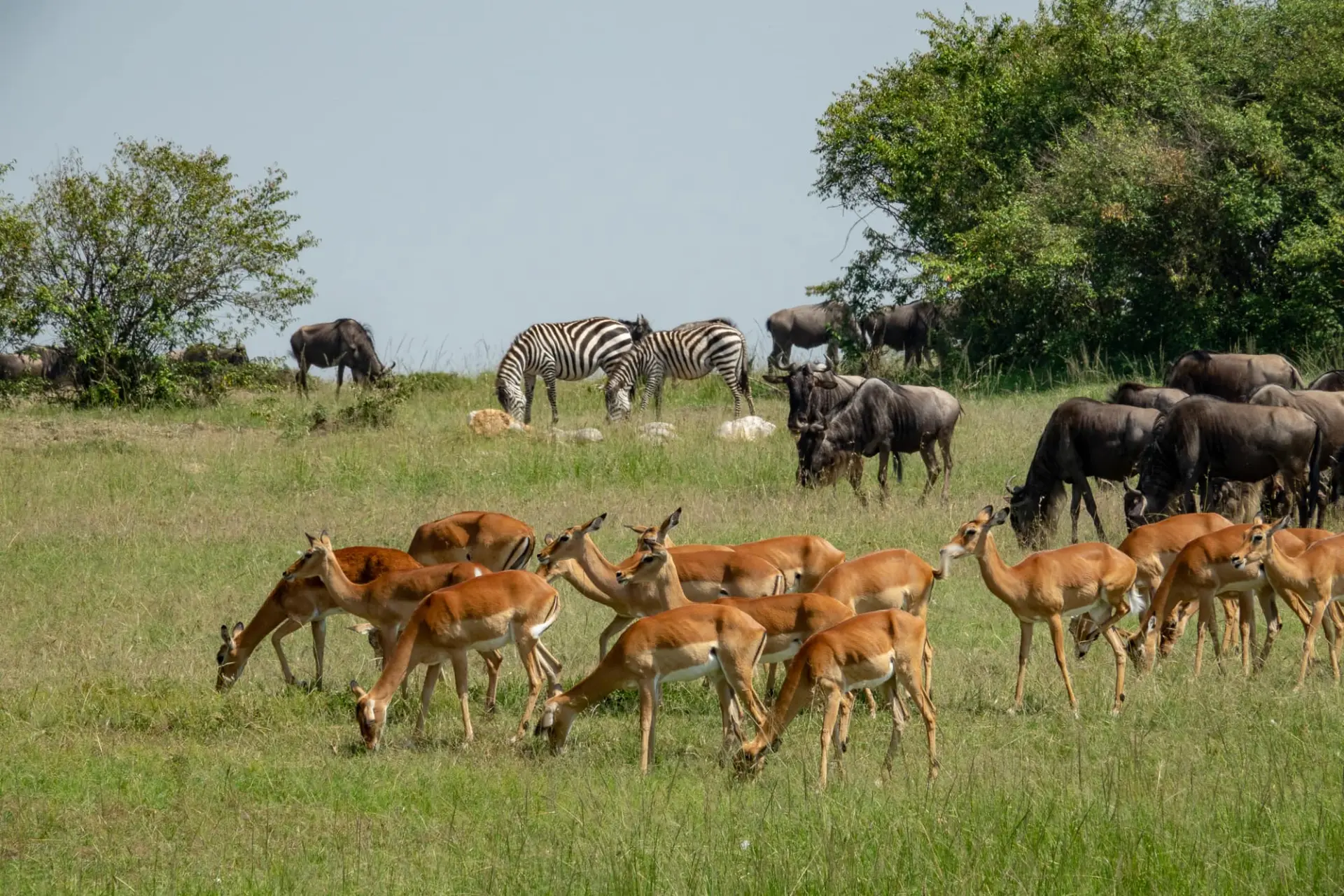
Masai Mara animals are usually the first thing travelers ask us about, lion, elephant and the rest of the Big Five, but Kenya’s full wildlife list runs far longer and varies noticeably by region.
- FromUSD 8503 day Nairobi Mara Big Five, a good starting trip for wildlife variety
- DurationRead time 10 min
- StartsNairobi
- Best forAnyone wanting to know what wildlife they will actually see
- StylePrivate or group joining
Rated 5.0 on Google from 46 reviews. Price confirmed in writing before you pay.
The Mara delivers the strongest predator odds anywhere in the country, while northern reserves like Samburu hold species you simply will not see further south, and the coast and Rift Valley lakes add their own specialities again.
This guide covers Masai Mara animals in detail, the wider Kenya wildlife list beyond the Mara, and exactly where to go for the specific sightings that matter most to you.
Highlights
- The Big Five, lion, elephant, buffalo, leopard and rhino, all findable in the Mara
- Cheetah sightings are consistently strong across the Mara’s open plains
- The Samburu Special Five live in the drier north and nowhere further south
- Amboseli offers Africa’s best large scale elephant herd viewing
- Flamingos and rhino sanctuaries define Lake Nakuru’s specific appeal
- No single park shows you everything, region genuinely changes what you see
Kenya Wildlife Viewing by Park, Guide Cost Per Person Sharing
| Park | Entry fee | Best for |
|---|---|---|
| Masai Mara | USD 100 to 200 | Big Five, cheetah, migration |
| Amboseli | about USD 90 | Elephant herds, Kilimanjaro backdrop |
| Samburu | about USD 70 to 80 | Samburu Special Five, dry country species |
| Lake Nakuru | about USD 90 | Rhino sanctuary, flamingos, leopard |
- Non resident adult fees shown, citizen and resident rates are considerably lower
- Fees change periodically, always confirm the exact current figure at booking
- See our Kenya park entry fees guide for the fuller current tariff across every major Kenyan park and conservancy
Get my exact price on WhatsApp
What Animals Can You See on a Kenya Safari
A typical Kenya safari covers the Big Five, lion, elephant, buffalo, leopard and rhino, alongside giraffe, zebra, hippo, crocodile and a long list of antelope species that varies by region and habitat type.
Masai Mara animals specifically include exceptionally strong lion and cheetah populations, plus the annual wildebeest migration, while northern and coastal parks each add their own distinct species not found in the Mara at all.
First time visitors often arrive with the Big Five as their main mental checklist, then leave far more impressed by the sheer volume and variety of plains game, giraffe, zebra, impala and topi moving in loose mixed herds across open grassland, a quieter but genuinely memorable part of most people’s first safari.
Your guide’s daily radio network with other drivers across the reserve is what actually turns a checklist into real sightings, sharing exact locations for a resting leopard or a pride on a fresh kill well before you would ever spot it unassisted from a passing vehicle window.
Masai Mara Animals: The Big Five and Beyond
All 5 of the classic Big Five live in the Mara, with lion sightings especially reliable thanks to well studied resident prides that guides track daily across the reserve’s open grassland.
Rhino numbers are lower here than at a dedicated sanctuary like Ol Pejeta or Lake Nakuru, so travelers specifically prioritising rhino sightings sometimes add one of those parks alongside their Masai Mara animals viewing for a fuller Big Five experience.
Elephant and buffalo herds are both genuinely common across the reserve, often crossing right in front of your vehicle, while hippo and crocodile congregate reliably around the Mara and Talek rivers for anyone who wants those specific sightings included in their itinerary too.
Where Can I See Cheetahs and Leopards
Cheetah sightings are consistently among the strongest anywhere in Africa across the Mara’s open plains, since the flat terrain suits their hunting style and makes spotting them from a vehicle considerably easier than in thicker bush.
Leopard are shier and harder to find, more often spotted along riverine woodland at dawn or dusk, with Lake Nakuru and the Mara’s forested river edges both offering genuinely good leopard odds if your guide knows recent territory.

Which Animals Are Endemic to Northern Kenya
Northern Kenya, particularly Samburu and Buffalo Springs, hosts species adapted to drier, hotter conditions that simply do not occur in the greener Mara ecosystem further south and west.
Grevy’s zebra, reticulated giraffe, gerenuk, Somali ostrich and beisa oryx are the standout examples, collectively known as the Samburu Special Five and a major reason travelers add a northern leg to their Kenya itinerary.
Alongside the Special Five, Samburu also holds healthy elephant, lion and leopard populations, so travelers are not trading away the classic sightings, they are simply adding an entirely different set of species on top of what the Mara already offers.
What Are the Samburu Special Five
The Samburu Special Five refers to 5 species distinctive to northern Kenya’s drier habitat, Grevy’s zebra, reticulated giraffe, gerenuk, Somali ostrich and beisa oryx, none of them commonly seen further south around the Mara.
See our 5 day Samburu, Ol Pejeta and Lake Nakuru safari page for an itinerary built specifically around finding all 5 alongside strong rhino viewing at Ol Pejeta.
Kenya Safari Animals List by Region
A useful Kenya safari animals list breaks down by region rather than treating the whole country as one uniform wildlife area, since habitat genuinely shapes which species you realistically will and will not encounter.
- Masai Mara: lion, cheetah, elephant, buffalo, giraffe, migration wildebeest and zebra
- Amboseli: large elephant herds, buffalo, lion, with Kilimanjaro as a backdrop
- Samburu: the Special Five plus elephant, lion and leopard in drier terrain
- Lake Nakuru: rhino sanctuary, flamingos, leopard and dense buffalo herds
- Tsavo: red elephant, lion and some of Kenya’s largest protected wilderness
Animals in Kenya You Might Not Expect
Beyond the well known animals in Kenya safari brochures usually feature, look out for aardvark, honey badger, serval cat and African wild dog, all present but genuinely uncommon sightings that reward patient, observant guiding.
Birdlife adds another dimension entirely, with over 1,000 recorded species across the country, flamingos at Lake Nakuru and fish eagles at Lake Naivasha among the easiest standout sightings for non specialist birders.
Nocturnal species like genet, civet and bushbaby occasionally show up on night drives at select conservancies, worth asking your guide about specifically if you enjoy the rarer, less commonly photographed side of Kenya’s wildlife list beyond the usual headline species.
Masai Mara Safari Animals During the Migration
Jul to Oct brings over a million wildebeest and hundreds of thousands of zebra into the Mara from the Serengeti, along with the predators that follow them, making this the single best window for Masai Mara safari animals density anywhere in the country.
See our great migration calendar for exact monthly timing before you plan a trip specifically around this seasonal event.
Kenya Wildlife on the Coast and at Rift Valley Lakes
Kenya wildlife is not limited to savannah parks, Watamu and Wasini offer dolphin and marine park snorkelling, while Lake Naivasha’s Crescent Island lets you walk among giraffe and zebra with no predators present at all.
See our Lake Naivasha boat ride and Crescent Island page for this specific predator free walking experience near Nairobi.
Hell’s Gate National Park nearby allows both walking and cycling among plains game, a genuinely different way to experience wildlife under your own power rather than from inside a vehicle, well worth adding alongside your main Masai Mara animals viewing if time allows.
Best Time to See Specific Masai Mara Animals
Predator sightings stay strong year round in the Mara, but Jul to Oct adds the migration’s sheer volume, while Jan to Mar and the drier months generally offer clearer visibility as vegetation thins out.
See our Kenya safari month by month guide for how timing affects both wildlife density and general trip comfort across the year.
Planning a Trip Around Specific Animals
Tell us which specific Masai Mara animals or wider Kenya wildlife you most want to see, rhino, the Samburu Special Five, or simply the strongest possible Big Five odds, and we will recommend the parks and season that genuinely deliver that priority.
See our where to see the Big Five in Kenya guide for a deeper breakdown focused specifically on those 5 species alone.
A clear answer up front about which Masai Mara animals matter most to you also helps us pick the right camp location within the reserve itself, since different areas of the Mara genuinely favour different species and behaviours at different times of year.
Combining Regions for the Fullest Wildlife Picture
No single park shows you everything Kenya offers, so travelers with a full week or more often combine the Mara with Samburu, Amboseli or Lake Nakuru for a genuinely wider range of Masai Mara animals and beyond in one trip.
See our 10 day Kenya safari page for our longest standard multi park route covering this fuller wildlife variety, or our 7 day Kenya safari page for a slightly shorter combined route.
Photography and Masai Mara Animals
Morning and late afternoon light gives the strongest photography results across almost every Kenyan park, since low angle sun brings out fur and feather detail that flat midday light tends to wash out entirely.
See our Kenya photography safaris page for vehicle, timing and lens advice specific to capturing Masai Mara animals and wider Kenya wildlife at their best.
Tsavo’s Red Elephants and Wide Open Wilderness
Tsavo East and West together form one of Kenya’s largest protected areas, known for elephants stained red from the local volcanic soil, along with lion, giraffe and considerably more open, remote feeling terrain than the busier Mara.
It suits travelers who have already seen the Mara’s classic Masai Mara animals and want a quieter, less crowded park for a second or third Kenya visit. See our Tsavo East and West safari page for the full itinerary, including current park fees and a realistic 3 day plan.
Nairobi National Park: Wildlife Minutes from the City
Remarkably, Nairobi itself borders a genuine national park, home to lion, rhino, giraffe and buffalo just a short drive from the airport, a useful option for travelers with only a few spare hours rather than a full day.
See our Nairobi National Park half day safari page if a quick introduction to Kenyan wildlife before or after your main trip appeals to your schedule, especially useful on an arrival or departure day with a few spare hours to fill.
Turn this Masai Mara animals guide into a real trip
Reading about Masai Mara animals is the fun part. Planning around it is where most people get stuck. Here is how we take you from an idea to a confirmed trip, step by step, with no surprises.
- Send your dates. Message us on WhatsApp with your travel dates, how many people are coming and the ages of any children. Tell us if you have a budget in mind. We plan with it, not around it.
- Get a written quote. We reply with a clear price per person, what it includes and what it does not. No hidden park fees and no vague extras. If a cheaper camp or a shorter route makes more sense, we say so.
- Tweak it until it fits. Change a camp, add a night or swap a park. Ask as many questions as you like. Changes cost nothing until you confirm.
- Confirm with a deposit. A deposit holds your vehicle, guide and rooms. You get a written confirmation with every detail and the date the balance is due.
- Travel day. Your driver guide meets you at your hotel or the airport with a name board. You have their number and ours for the whole trip.
What every trip with us includes
Every Masai Mara animals plan we put together comes with the basics done properly. You ride in a safari vehicle with a pop up roof, with a professional driver guide who knows the parks. Water is in the cooler box, and park fees are sorted in advance so you do not stand in a queue at the gate.
We also stay reachable. If something changes on the road, a flat tyre, a closed route or a sudden storm, we sort it and keep you posted on WhatsApp.
Paying safely
We share payment details in writing only, and every payment gets a receipt. The payment options and the balance date sit on your written quote, so nothing is left to memory or a phone call.
Why book with a Nairobi team
We live here. We drive these roads all year, we know which camps are honest about their photos, and we know when a park is too busy to enjoy. That local knowledge is what turns a good Masai Mara animals into a great one. Our Google rating sits at 5.0 from 46 reviews, and we plan to keep it that way.
Ready when you are. Send us a message and we will put a plan together for you shortly.
Questions people ask
What animals can you see on a Kenya safari?
The Big Five, lion, elephant, buffalo, leopard and rhino, plus giraffe, zebra, hippo and many antelope species. Masai Mara animals specifically include exceptionally strong lion and cheetah populations alongside the annual migration.
Where can I see cheetahs and leopards?
Cheetah sightings are strong across the Mara’s open plains, ideal terrain for spotting them. Leopard are shier, more often found along riverine woodland at dawn or dusk in the Mara and at Lake Nakuru.
Which animals are endemic to northern Kenya?
Grevy’s zebra, reticulated giraffe, gerenuk, Somali ostrich and beisa oryx, collectively the Samburu Special Five, adapted to drier northern habitat and not commonly seen among Masai Mara animals further south.
What are the Samburu Special Five?
Grevy’s zebra, reticulated giraffe, gerenuk, Somali ostrich and beisa oryx, 5 species distinctive to northern Kenya’s dry country reserves like Samburu and Buffalo Springs.
Are Masai Mara animals different from Amboseli’s wildlife?
Yes, both offer strong Big Five viewing, but Amboseli is known specifically for its large elephant herds against a Kilimanjaro backdrop, while the Mara offers the strongest cheetah and migration season sightings.
When is the best time to see the migration?
Jul to Oct brings over a million wildebeest and their following predators into the Mara from the Serengeti, the single best window for the highest density of Masai Mara animals anywhere in the country.
Can I see rhinos in the Masai Mara?
Yes, but numbers are lower than at a dedicated sanctuary. Many travelers add Ol Pejeta or Lake Nakuru alongside their Masai Mara animals viewing for stronger, more reliable rhino sightings across a longer combined itinerary.
Is Kenya wildlife only found in savannah parks?
No, Kenya wildlife also includes coastal dolphins and marine parks at Watamu and Wasini, plus a predator free walking safari among giraffe and zebra on Lake Naivasha’s Crescent Island.
Official information: Kenya Wildlife Service.
Ready when you are. Send your dates and group size. We reply with a clear price and a plan you can change.
Chat on WhatsApp